Repair vs. Replace Freezer Calculator
Input Details
Result Analysis
Enter values to see recommendation
Waiting for Input...
Please enter the repair cost, new unit price, and age of your freezer to generate a recommendation based on industry standards.
A new Energy Star unit could save you approximately $22.50/year compared to an older model.
It’s 2 AM. You wake up thirsty, walk into the kitchen, and open your upright freezer. It’s warm. Your ice cream is soup. Your frozen vegetables are a mushy mess. Panic sets in immediately-not just because you’ve lost food, but because you’re staring at a broken machine and wondering if you should call a technician or drive to the store tomorrow morning.
This is the classic home repair dilemma. Do you spend money fixing something old, or do you bite the bullet and buy new? The answer isn’t always obvious, and it certainly isn’t one-size-fits-all. If you guess wrong, you could end up spending $400 on a repair for a unit that dies again in six months. Or worse, you might throw away a perfectly good compressor because a $15 thermostat failed.
To make this decision without losing sleep, you need to look past the immediate shock of the breakdown. We need to talk about the age of the unit, the specific part that failed, and the hidden costs of energy efficiency. Here is how to calculate whether repairing or replacing your freezer makes financial sense.
The Golden Rule: The 50% Threshold
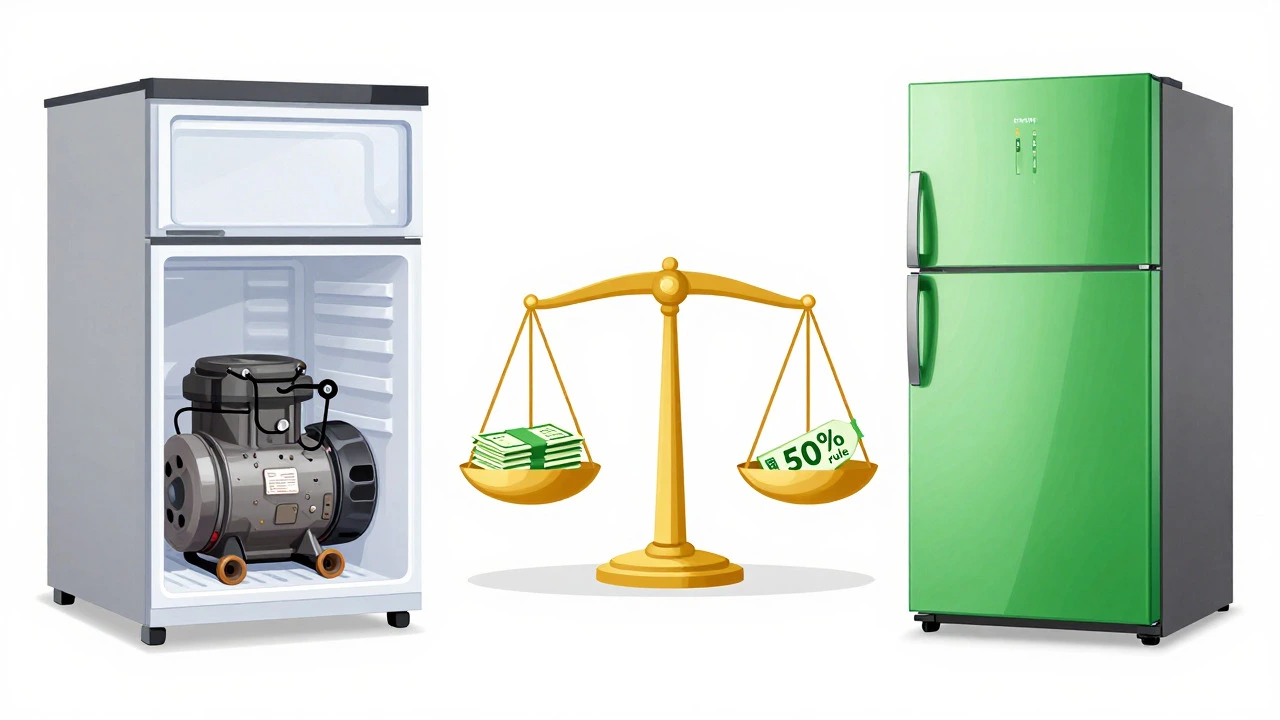
In the appliance industry, there is a widely accepted heuristic known as the "50% rule." It sounds simple, but it requires a bit of math. If the cost of the repair is more than 50% of the price of a brand-new replacement unit, you should generally replace the appliance. However, this rule has a major caveat: the age of your current freezer.
Let’s break down why this matters. A standard top-freezer refrigerator or a standalone upright freezer typically lasts between 10 and 15 years. High-end built-in models might stretch to 20 years, while budget units often fail sooner. If your freezer is 12 years old and the repair quote is $300, but a comparable new model costs $600, you are right at that 50% line. But here is the catch: a 12-year-old freezer is near the end of its natural lifespan. Even if you fix the current issue, another component-like the door seal or the evaporator fan-is likely to fail soon. Spending half the cost of a new unit on an old one is usually a bad investment.
On the flip side, if your freezer is only three years old and under warranty, the repair cost might be zero or very low. In that case, the 50% rule doesn't apply because the risk of future failure is minimal. The rule works best for appliances that are middle-aged (5-10 years old). For these units, a repair under 50% of the replacement cost is usually worth it, provided the core components like the compressor are still healthy.
Diagnosing the Problem: Cheap Fixes vs. Expensive Ones
Before you even call a professional, you can often narrow down the issue. Some problems are dirt cheap to fix, making repair the obvious choice regardless of the unit's age. Other failures signal the death knell of the appliance.
| Issue | Symptoms | Avg. Repair Cost | Verdict |
|---|---|---|---|
| Door Gasket Failure | Frost buildup inside, warm air entering, high energy bills | $50 - $150 | Repair (Always) |
| Thermostat Malfunction | Freezer too warm or too cold, compressor running constantly | $100 - $200 | Repair (If under 10 yrs) |
| Defrost Heater/Fan | Ice accumulation on back wall, poor cooling | $150 - $300 | Repair (Worth it) |
| Compressor Failure | No humming sound, unit never gets cold, hot sides | $400 - $700+ | Replace (Almost always) |
| Refrigerant Leak | Gradual loss of cooling, oily residue near lines | $300 - $600 | Replace (Due to complexity) |
Notice the pattern? Mechanical issues involving seals, fans, and thermostats are relatively inexpensive. These parts wear out over time due to friction and heat cycles, but they don’t necessarily mean the whole machine is dead. A bad door gasket is like a leaky tire; you patch it, and you keep driving. A compressor failure, however, is like a blown engine. The compressor is the heart of the freezer. When it goes, the entire system needs to be evacuated, repaired, and recharged with refrigerant. This labor-intensive process rarely makes financial sense unless the freezer is a high-end, custom-built unit that would cost thousands to replace.
The Hidden Cost: Energy Efficiency
We often forget that keeping an appliance running costs money every single month. An older freezer is almost always less energy-efficient than a modern one. Regulations have tightened significantly over the last two decades. A freezer manufactured in 2010 consumes roughly 20-30% more electricity than a comparable model from 2025.
Let’s put some numbers on this. If your old freezer uses 400 kWh per year and your local electricity rate is $0.15 per kWh, you are paying about $60 a year to run it. A new, Energy Star-rated freezer might use only 250 kWh per year, costing you $37.50. That’s a savings of $22.50 annually. Over five years, that adds up to $112.50. While this won’t pay for a new unit on its own, it reduces the total cost of ownership. If you combine this with the reliability of a new unit and a manufacturer’s warranty, the long-term value shifts heavily toward replacement.
Furthermore, newer freezers use eco-friendly refrigerants like R-600a (isobutane) instead of older, ozone-depleting gases. If your old unit has a leak, finding a technician who stocks the old refrigerant can be difficult and expensive. New units are designed for easier servicing and better environmental standards.
When to Definitely Keep and Repair
There are scenarios where replacing the freezer is a waste of money. First, check your warranty. Many manufacturers offer extended warranties or service plans. If you paid for coverage, the repair might only require a small deductible. In this case, repair is the clear winner.
Second, consider the type of freezer. Chest freezers are notoriously durable. They lack complex electronic controls, defrost systems, and intricate vents. If a chest freezer breaks, it’s often a simple mechanical issue that can be fixed for under $100. Because they are so efficient and robust, a 15-year-old chest freezer might still be worth repairing if the compressor is working. Upright freezers and refrigerator-freezer combos are more fragile due to their frost-free mechanisms. These have more moving parts (fans, heaters, sensors) that can fail, making them less candidates for long-term repairs.
Third, look at the market availability. Are you looking for a specific size or style? Built-in panels or custom cabinetry can make replacement incredibly expensive and disruptive. If replacing the unit means remodeling your kitchen, the cost of repair-even a high one-becomes justified by the avoidance of construction costs.
When to Pull the Trigger on Replacement
If your freezer is over 10 years old and the compressor has failed, stop reading and start shopping. The labor cost alone for a compressor replacement often exceeds $500. Add the cost of the part, and you are approaching the price of a mid-range new unit. Why invest that much in a machine that has already given you a decade of service?
Also, consider your lifestyle changes. Did you recently have a baby? Are you meal prepping more? If your storage needs have increased, an old, smaller unit might no longer serve you well. Upgrading allows you to get a larger capacity, better organization, and smart features like Wi-Fi connectivity that alert you if the temperature rises. These quality-of-life improvements are hard to quantify but add significant value to a new purchase.
Finally, think about the hassle factor. Dealing with repair technicians involves scheduling conflicts, waiting for parts, and potential repeat visits. Buying a new unit is a one-time event. You order it, it arrives, you plug it in, and you move on. For many people, the convenience of a fresh start outweighs the marginal savings of a repair.
How to Decide: A Quick Checklist
To simplify the decision-making process, ask yourself these five questions:
- Is the unit under 5 years old? If yes, repair it (unless the damage is catastrophic).
- Is the repair cost less than 50% of a new unit? If yes, lean towards repair.
- Is the problem with the compressor or refrigerant system? If yes, replace it.
- Do you have a warranty or service plan? If yes, use it and repair.
- Is the unit a simple chest freezer? If yes, it’s likely worth repairing due to durability.
If you answered "no" to most of these, it’s time to say goodbye to the old freezer. Check local recycling programs or donation centers. Many appliance stores offer haul-away services when you buy a new unit, which saves you the headache of disposal fees.
Ultimately, the goal is peace of mind. A reliable freezer protects your food and your wallet. Don’t let sentimentality keep a dying machine alive. Use the data, check the quotes, and make the choice that saves you stress in the long run.
How much does it cost to repair a freezer on average?
The average cost to repair a freezer ranges from $100 to $300 for minor issues like thermostats, fans, or door seals. Major repairs involving compressors or refrigerant leaks can cost between $400 and $700 or more, depending on labor rates in your area.
What is the average lifespan of a freezer?
A typical upright freezer or refrigerator-freezer combination lasts between 10 and 15 years. Chest freezers often last longer, sometimes up to 20 years, due to their simpler mechanical design and lack of frost-free systems.
Is it worth repairing a 15-year-old freezer?
Generally, no. At 15 years old, a freezer is at the end of its expected lifespan. Unless the repair is extremely cheap (under $100) and the unit is a highly durable chest freezer, the risk of further breakdowns and higher energy costs makes replacement the smarter financial choice.
Can I fix a freezer myself to save money?
Yes, for simple issues. Replacing a door gasket, cleaning condenser coils, or swapping out a visible thermostat can often be done by a DIYer with basic tools. However, any repair involving electrical components behind panels or refrigerant lines should be left to professionals to avoid safety hazards and voiding warranties.
Why is my freezer running but not getting cold?
This symptom usually points to a few common culprits: a faulty evaporator fan motor (which circulates cold air), a failed defrost heater (causing ice buildup that blocks airflow), or a sealed system issue like a refrigerant leak or compressor failure. Diagnosing this often requires a multimeter and technical knowledge.