Dryer Repair Cost Calculator
Is Your Dryer Worth Fixing?
Enter your repair cost to see if fixing your 10-year-old dryer makes sense based on expert guidelines.
You walk into the laundry room and hear it-the loud clunk, the strange squeal, the dryer just stopping mid-cycle. Again. You’ve had this machine for ten years. It’s worked fine, mostly. But now? It’s acting up. You stare at it, wondering: is a 10-year-old dryer worth fixing? Or should you just bite the bullet and buy a new one?
How long do dryers actually last?
Most dryers are built to last between 10 and 13 years. That’s the average lifespan according to appliance manufacturers and repair professionals. A 10-year-old dryer isn’t ancient-it’s right on the edge of its expected life. Think of it like a car with 150,000 miles. It’s not broken yet, but it’s starting to show wear.
Some dryers last longer. I’ve seen units from the early 2000s still running in homes where owners did basic maintenance: cleaned the lint trap after every load, checked the vent hose yearly, didn’t overload it. Others die at eight years because they were shoved into tight spaces, choked by clogged vents, or used for heavy loads every single day.
If your dryer is hitting the 10-year mark and still works most of the time, you’re ahead of the curve. But now’s the time to start thinking ahead.
What’s wrong with it?
Not all problems are created equal. The cost to fix a dryer can range from $50 to $300, depending on the issue. Here are the most common fixes-and whether they make sense at this age.
- Heating element failure: This is one of the most frequent issues. Replacing it costs $80-$150, including labor. If your dryer tumbles but doesn’t heat, this is likely the culprit. At 10 years, replacing this part is usually worth it.
- Thermal fuse blown: A simple $10-$25 part that protects the dryer from overheating. Easy fix. Always replace this if it’s blown-it’s a safety issue.
- Drum rollers or belt worn out: If your dryer makes a loud rumbling or squeaking noise, it could be the rollers or belt. Replacement runs $100-$200. At 10 years, this is still a reasonable repair if the rest of the unit is solid.
- Motor failure: If the drum won’t spin at all, the motor might be dead. Replacing it costs $200-$300. That’s close to the price of a new budget dryer. At this point, you’re better off replacing the whole unit.
- Control board failure: Modern dryers have electronic panels. If the display is glitchy or buttons don’t respond, the control board may be fried. Repair: $250-$400. At 10 years, this is rarely worth it.
Here’s the rule of thumb: if the repair costs more than half the price of a new dryer, walk away. A basic new dryer runs $400-$600. So if your fix is over $300, you’re flirting with a bad decision.
Is your dryer energy efficient?
A 10-year-old dryer is probably using 20-30% more electricity than a new ENERGY STAR model. That adds up. Let’s say your dryer runs 5 loads a week. At $0.15 per kWh, an older model uses about $120 a year in electricity. A new efficient model cuts that to $85. That’s $35 saved annually.
Over five years? That’s $175. Now add the cost of repairs. If you’ve spent $200 on fixes in the last two years, you’re already ahead of the game by replacing it now. New dryers also dry faster, which means less time and energy wasted.
And don’t forget rebates. Many utility companies offer $50-$150 cash back for switching to an ENERGY STAR dryer. Check your local provider. That could cover half the cost of a new unit.
What’s the cost of waiting?
Waiting to replace a 10-year-old dryer is risky. These machines don’t just stop working-they fail in inconvenient ways.
Imagine this: it’s Saturday morning. You’ve got a full load of towels. The dryer dies. You wait a day for a repair tech. They show up Monday. You’ve got no clean towels for the week. Kids are out of school. Laundry piles up. You’re stressed. You end up using the laundromat-$5 per load, 3 loads a week. That’s $60 in a weekend.
That’s not just money. It’s time. It’s peace of mind. A dryer that’s on its last legs becomes a liability. You start dreading laundry day. You avoid doing big loads. You start hanging clothes up. You feel like you’re living in the 1950s.
Replacing it before it breaks completely gives you control. You can shop around. You can wait for a sale. You can pick the right model. You’re not forced into a rushed decision.
When to replace it, even if it’s still working
There are signs your dryer is done-even if it still turns on.
- You’ve had two or more major repairs in the last two years.
- The drum is cracked or warped-it’s not spinning evenly anymore.
- It’s taking two cycles to dry a normal load.
- You hear metal-on-metal grinding or see smoke (yes, really).
- The exterior is rusted or the door seal is crumbling.
If any of these are true, you’re not fixing a dryer. You’re patching a sinking ship.
Also, consider your lifestyle. If you have kids, pets, or a large household, a reliable dryer isn’t a luxury-it’s a necessity. A breakdown during busy season can throw your whole routine off.
What to look for in a new dryer
If you’re replacing it, here’s what actually matters:
- Capacity: 7.0-8.0 cubic feet is ideal for most families. Smaller units struggle with comforters and towels.
- Moisture sensors: Don’t buy a dryer without them. They automatically shut off when clothes are dry-saving energy and preventing shrinkage.
- Steam cycle: Not essential, but great for reducing wrinkles and freshening clothes without washing.
- Stackable or ventless: If you live in an apartment or have limited space, consider a ventless heat pump dryer. They cost more upfront but use 50% less energy.
- Warranty: Look for at least a one-year full warranty. Some brands offer 5-year limited coverage on the motor.
Brands like LG, Whirlpool, and Electrolux consistently rank high in reliability. Avoid the cheapest models-they often skimp on motors and drums.
What to do with your old dryer
Don’t just leave it on the curb. Many cities offer free appliance pickup for recycling. Some retailers will haul away your old unit when you buy a new one-sometimes for free.
Recycling your dryer keeps hazardous materials like copper and refrigerant out of landfills. Plus, you might get a $25-$50 rebate from your utility company just for turning it in.
If it still works, consider donating it. Organizations like Goodwill or local charities often take working appliances. You get a tax deduction, and someone else gets a reliable dryer.
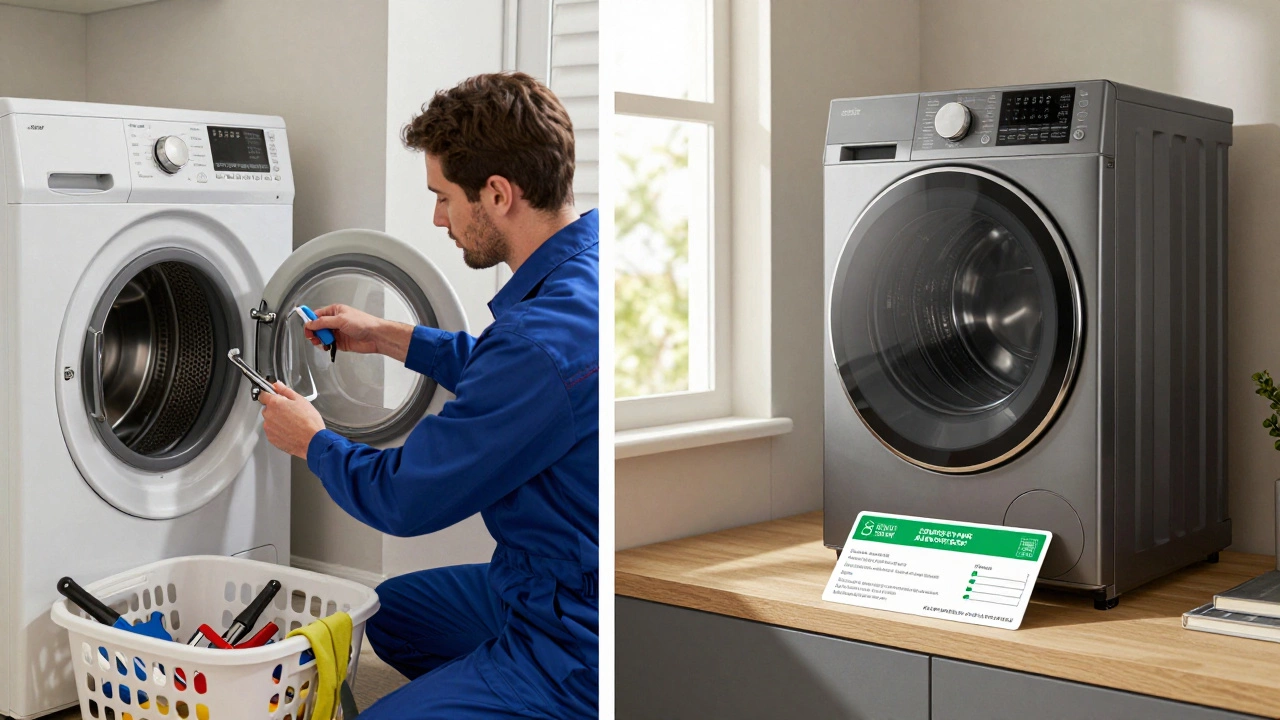
Final call: Fix or replace?
Here’s a simple decision tree:
- Is the repair cost under $150? → Fix it. You’re still in the sweet spot.
- Is the repair cost $150-$300? → Check the age and usage. If you use it daily and it’s been reliable, fix it. If it’s been breaking down often, replace it.
- Is the repair cost over $300? → Replace it. You’re paying more than half the price of a new unit.
- Are you tired of it? → Replace it. Your peace of mind matters more than you think.
At 10 years old, your dryer has given you good service. But it’s not a forever machine. Fixing it once or twice is smart. Fixing it every year? That’s not saving money-that’s throwing it away.
Replace it before it leaves you stranded. Pick a model that fits your life. And don’t forget to clean that vent. Your next dryer will thank you.
Is it worth repairing a 10-year-old dryer?
It depends on the repair cost and how often it’s broken. If the fix is under $150 and the dryer has been reliable, yes. If it’s over $300 or you’ve had multiple repairs in the last two years, replacing it is smarter.
How long should a dryer last before replacement?
Most dryers last 10 to 13 years. After 10 years, reliability drops significantly. Even if it still works, consider replacement if repairs are frequent or energy use is high.
What’s the most common reason a 10-year-old dryer stops working?
The heating element fails most often, followed by worn drum rollers and blown thermal fuses. Motor and control board failures are less common but more expensive to fix.
Can a 10-year-old dryer be energy efficient?
No. Dryers older than 10 years typically use 20-30% more energy than new ENERGY STAR models. Over time, that adds up to $35-$50 extra per year in electricity costs.
Should I replace my dryer before it breaks?
Yes-if you’re already spending $150+ on repairs, or if you’re tired of waiting for it to work. Replacing it before it fails gives you time to choose the right model and take advantage of sales or rebates.