Extractor Fan Sizing & Noise Calculator
Stop guessing. Enter your room details below to find the perfect fan specifications.
Recommended Airflow
Max Noise Level
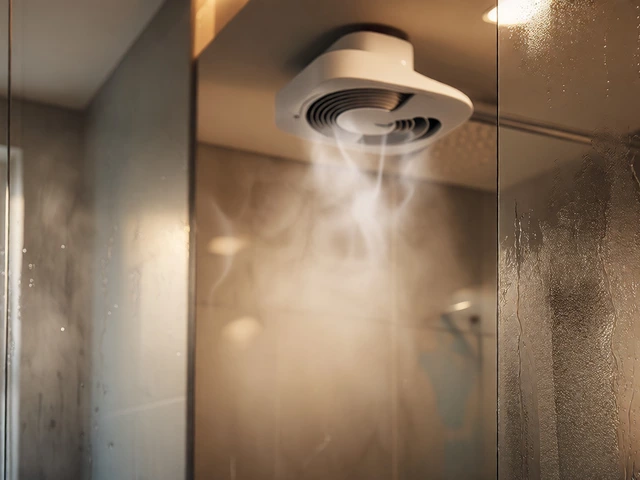
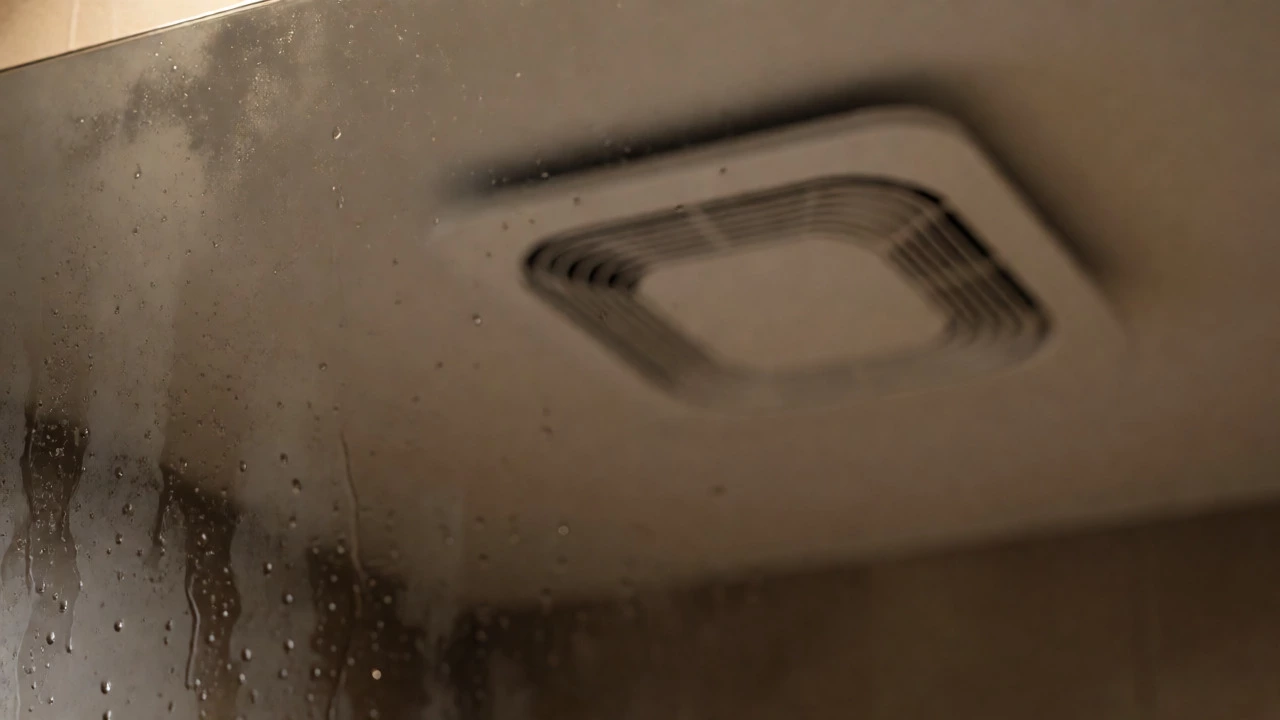
0.0 SonesYou’ve got that persistent fog on your mirror after a shower. Or maybe you notice a faint musty smell lingering in the kitchen even after you’ve wiped down the counters. These are classic signs that your current extractor fan is either undersized, broken, or just not doing its job. Buying a new one seems simple until you’re standing in the hardware aisle staring at boxes with confusing numbers like "CFM," "Sones," and "Static Pressure." Which one actually fixes your problem? The wrong choice means paying for a unit that’s too loud to run or too weak to remove moisture, leading to mold growth that costs way more than the fan itself.
Why Sizing Matters More Than Brand Name
Most people think any fan labeled "bathroom exhaust" will work. That’s a mistake. An extractor fan is a mechanical device designed to remove humid air, odors, and pollutants from a specific space. If it doesn’t match the volume of the room, it fails. Think of it like buying shoes: if they don’t fit the foot, the brand logo on the tongue doesn’t matter. In Vancouver, where our damp climate already challenges indoor air quality, getting this right is critical. You need to calculate exactly how much air needs to be moved per minute to keep your space dry and fresh.
Calculate Your Room’s Airflow Needs (CFM)
The core metric you need is Cubic Feet per Minute (CFM). This number tells you how many cubic feet of air the fan can move in one minute. To find out what you need, measure your room’s length, width, and height in feet. Multiply those three numbers together to get the total cubic footage. Then, divide that by the recommended air change rate. For bathrooms, you generally want to replace all the air 8 times per hour. So, take your total cubic feet, multiply by 8, and divide by 60 minutes. Here is the quick formula:
- Bathrooms: (Length × Width × Height × 8) ÷ 60 = Required CFM.
- Kitchens: Aim for 100 CFM for every linear foot of range hood width, or roughly 15-20 CFM per square foot of floor area for general ventilation.
If you have a large master bath with a soaking tub and double showers, add extra capacity. Under-sizing is the most common regret homeowners report. It’s better to go slightly higher on CFM than lower, provided you manage the noise levels correctly.
| Room Type | Floor Area (Sq Ft) | Minimum CFM Rating | Notes |
|---|---|---|---|
| Small Bathroom | Under 50 | 50 CFM | Sufficient for toilets/sinks; often inadequate for showers. |
| Standard Bathroom | 50 - 70 | 80 - 100 CFM | Good for single shower/tub combos. |
| Master Bathroom | Over 70 | 110+ CFM | Required for large showers, jacuzzis, or dual sinks. |
| Kitchen (Range Hood) | N/A | 100 CFM per foot | Add 50 CFM if ductwork exceeds 10 feet. |
Understanding Noise Levels: Sones vs. Decibels
A powerful fan that sounds like a jet engine taking off inside your house is useless because nobody turns it on. Manufacturers use two metrics for noise: decibels (dB) and sones. Decibels measure sound intensity logarithmically, which makes small changes feel huge. Sones measure perceived loudness linearly, making them easier to compare. A quiet library is about 0.5 sones. A normal conversation is around 4 sones. Most modern residential fans operate between 0.3 and 4.0 sones.
Here is the rule of thumb: Look for fans rated at 1.0 sone or less for bedrooms and bathrooms where you might relax. Anything above 3.0 sones is noticeable and potentially annoying during long showers. High-CFM fans often come with "insulated housings" or variable speed motors to keep noise down while moving more air. Don’t ignore this spec; it determines whether you’ll actually use the fan consistently.
Ducting and Static Pressure: The Hidden Killer
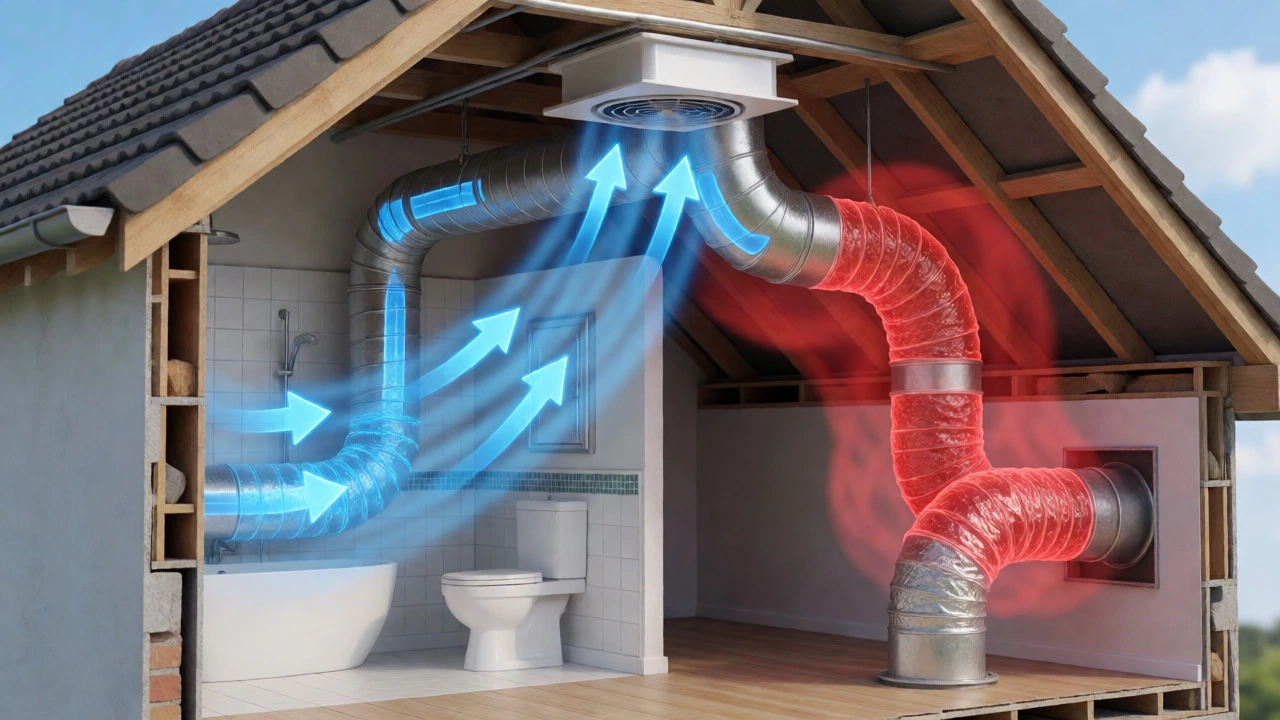
Even the best fan fails if the path for the air is blocked. Static pressure measures the resistance the fan faces pushing air through the ductwork. Flexible aluminum ducts are easy to install but create high resistance due to their ribbed interior. Rigid metal ducts offer lower resistance and better airflow. If your duct run is long, has multiple elbows, or goes through an attic with tight spaces, you need a fan with higher static pressure capability.
In older homes in cities like Vancouver, existing ducts might be crushed, kinked, or clogged with dust bunnies. Before buying a new motor, check the exit point outside. Is there a flap? Does it open freely? A stuck damper can reduce efficiency by 50%. If your duct run is longer than 10-15 feet, consider an inline duct fan instead of a ceiling-mounted unit. Inline fans sit within the ductwork and push air more effectively over longer distances.
Control Features: Humidity Sensors and Timers
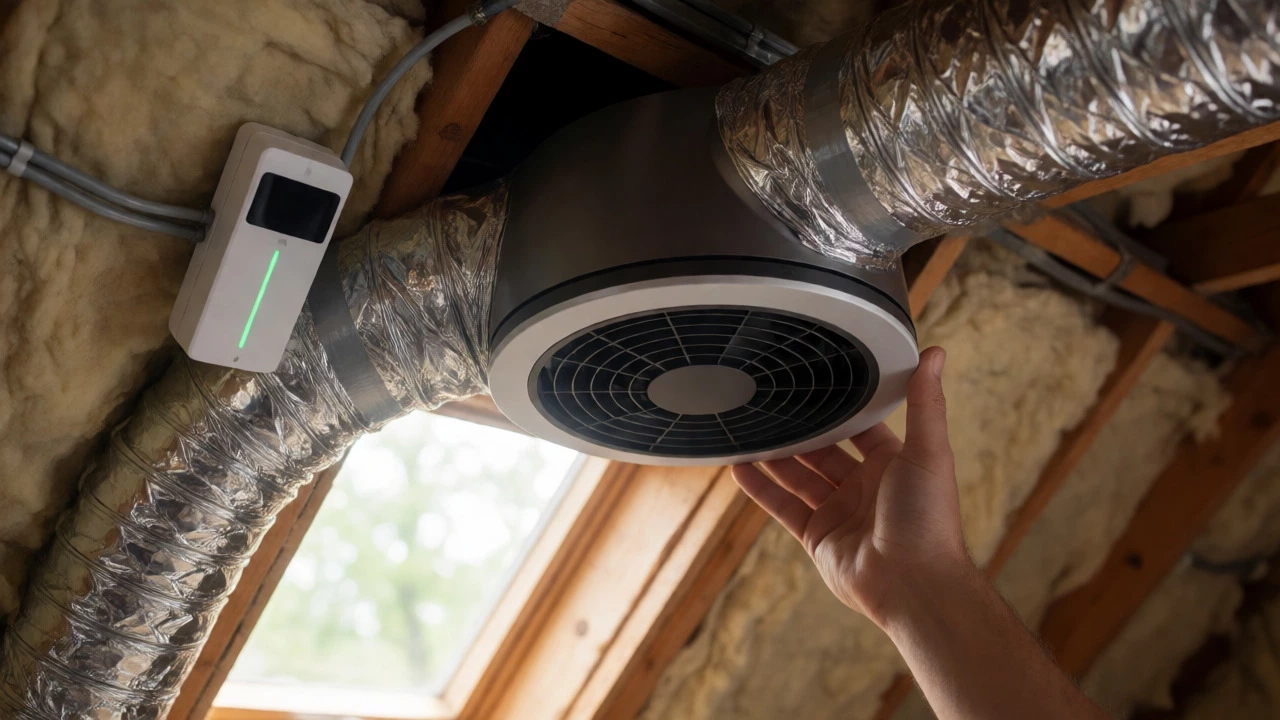
Manual switches are unreliable. People forget to turn them on before showering or leave them running for hours. Modern units offer smart features that automate the process. A humidity sensor automatically activates the fan when moisture levels rise above a set threshold, typically around 60% relative humidity. This ensures the fan runs only when needed, saving energy and extending motor life.
Timers are another great addition. They allow the fan to continue running for 15-30 minutes after you flip the switch off, clearing residual steam. Some high-end models connect to Wi-Fi, letting you monitor usage via an app, but for most homeowners, a simple built-in humidity sensor is the best value. It removes the human error factor entirely.
Installation Tips to Avoid Common Mistakes
Once you’ve picked the right specs, installation determines performance. First, always vent to the outdoors, never into an attic or crawlspace. Dumping moist air into insulation causes mold and rot within months. Second, ensure the duct is insulated if it passes through unconditioned spaces like attics. Without insulation, warm moist air hits cold duct walls, condenses, and drips back into the fan housing.
Use rigid ducting whenever possible. If you must use flexible ducting, stretch it as straight and taut as possible to minimize friction losses. Seal all joints with foil tape or mastic sealant-never use standard cloth duct tape, which degrades quickly under heat and humidity. Finally, check local building codes. In British Columbia, the BC Building Code requires specific ventilation rates for bathrooms, so verify your chosen model meets these standards to pass inspection if you ever sell your home.
Can I use a window fan instead of an extractor fan?
Generally, no. Window fans are designed for general air circulation and cooling, not for removing concentrated moisture and odors from a small enclosed space like a bathroom. They lack the static pressure needed to push air against gravity and wind resistance effectively. For consistent humidity control, a dedicated ducted extractor fan is required.
How do I know if my current fan is broken or just dirty?
Remove the cover and inspect the blades. If they are coated in thick dust or grease, cleaning might restore airflow. However, if the motor hums loudly but the blades spin slowly, or if the fan vibrates excessively, the bearings are likely worn out. In these cases, replacement is usually cheaper and more reliable than repair.
Do I need a GFCI outlet for my bathroom extractor fan?
Yes, electrical codes in Canada and the US require Ground Fault Circuit Interrupter (GFCI) protection for outlets in bathrooms near water sources. While some hardwired fans may not plug directly into a GFCI outlet, the circuit breaker protecting the line should often be GFCI-protected depending on local amendments to the electrical code. Always consult a licensed electrician for hardwired installations.
What is the difference between an inline fan and a ceiling-mounted fan?
A ceiling-mounted fan sits directly in the bathroom ceiling and pushes air into a short duct. An inline fan is installed within the ductwork, often in the attic. Inline fans are quieter in the living space because the motor is away from the room, and they handle longer duct runs better due to higher static pressure capabilities. Ceiling fans are easier to install in retrofits without attic access.
How long should an extractor fan last?
With proper maintenance, such as annual cleaning of blades and grilles, a quality extractor fan should last between 10 and 15 years. Motors in high-humidity environments degrade faster if not properly ventilated or if the unit is undersized and forced to run continuously at maximum load.