Electric Hob Replacement Safety Calculator
Is Your Replacement Safe to DIY?
Answer these questions to determine if you need a licensed electrician for your electric hob replacement.
Answer the questions above to see your safety assessment.
Replacing an electric hob might seem like a simple swap - pull out the old one, slide in the new one, and turn on the power. But here’s the truth: if you’re not sure what’s under your countertop, you could be risking your safety, your home, or your warranty. And no, you don’t always need an electrician - but you often do. Let’s cut through the confusion.
What Exactly Is an Electric Hob?
An electric hob, also called an electric cooktop, is the flat surface on your kitchen counter with heating elements underneath. Unlike gas stoves, it doesn’t use flames. Instead, it runs on electricity, usually 240 volts in North America. That’s double the standard household voltage. These units draw serious power - often 3,000 to 5,000 watts. That’s more than your clothes dryer.
Most electric hobs connect directly to a dedicated circuit. That means there’s a special breaker in your panel, and a thick cable runs from the panel to a junction box under your countertop. It’s not plugged into a regular outlet. If you’ve ever tried to plug a heavy-duty appliance into a standard 15-amp outlet and tripped the breaker, imagine that but with 40 amps and no plug.
When You Can Skip the Electrician
There’s one situation where you might not need an electrician: if you’re replacing the hob with an identical model and the wiring is already in good shape. Say your old hob was a 30-inch, 5,000-watt unit with a 40-amp circuit. You’re swapping it for the same exact model. The mounting dimensions match. The power requirements match. The junction box is clean, dry, and properly labeled.
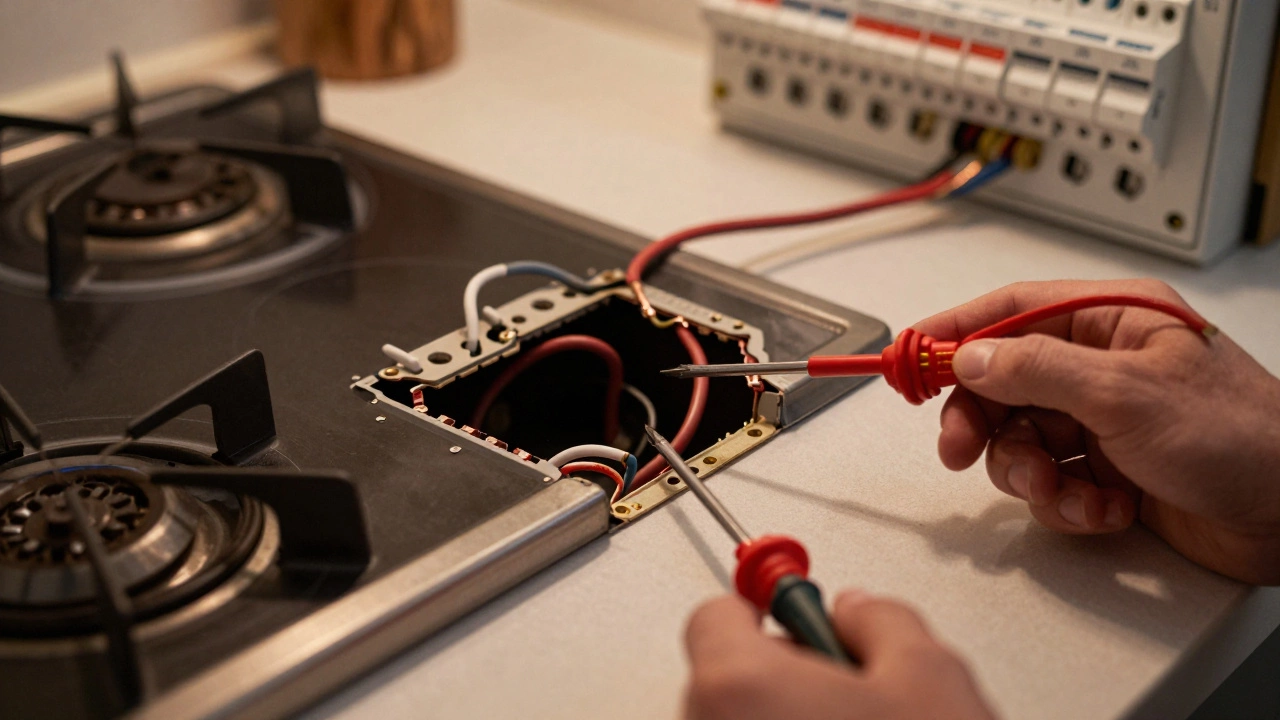
In that case, you can turn off the breaker, unplug the old unit (yes, even hardwired units have a disconnect), unhook the wires, and connect the new one. You’ll need a screwdriver, wire strippers, and maybe a voltage tester. You’ll also need to read the manual. Most manufacturers include wiring diagrams. Follow them exactly.
But here’s the catch: even if you’re confident, you still need to check local codes. In Vancouver, electrical work on hardwired appliances requires a permit if it’s not a like-for-like replacement. If you’re changing the size, wattage, or type - even slightly - you’re now doing regulated electrical work.
When You Absolutely Need an Electrician
You need a licensed electrician if any of these apply:
- You’re upgrading to a higher-wattage hob (e.g., from 4,000W to 7,000W)
- You’re switching from a 30-inch to a 36-inch model (changes the circuit load)
- The old wiring looks frayed, discolored, or smells like burnt plastic
- The circuit breaker keeps tripping
- You’re installing a smart hob with Wi-Fi, touch controls, or induction tech - these often need dedicated neutral wires
- You’re replacing the hob during a kitchen remodel and the junction box was moved or removed
Induction hobs are especially tricky. They don’t just need power - they need clean, stable voltage. A weak or shared circuit can cause erratic behavior, error codes, or even damage the unit. Electricians know how to test for voltage drop, ground integrity, and harmonic interference. Most DIYers don’t have the tools for that.
What Happens if You Do It Yourself and Something Goes Wrong?
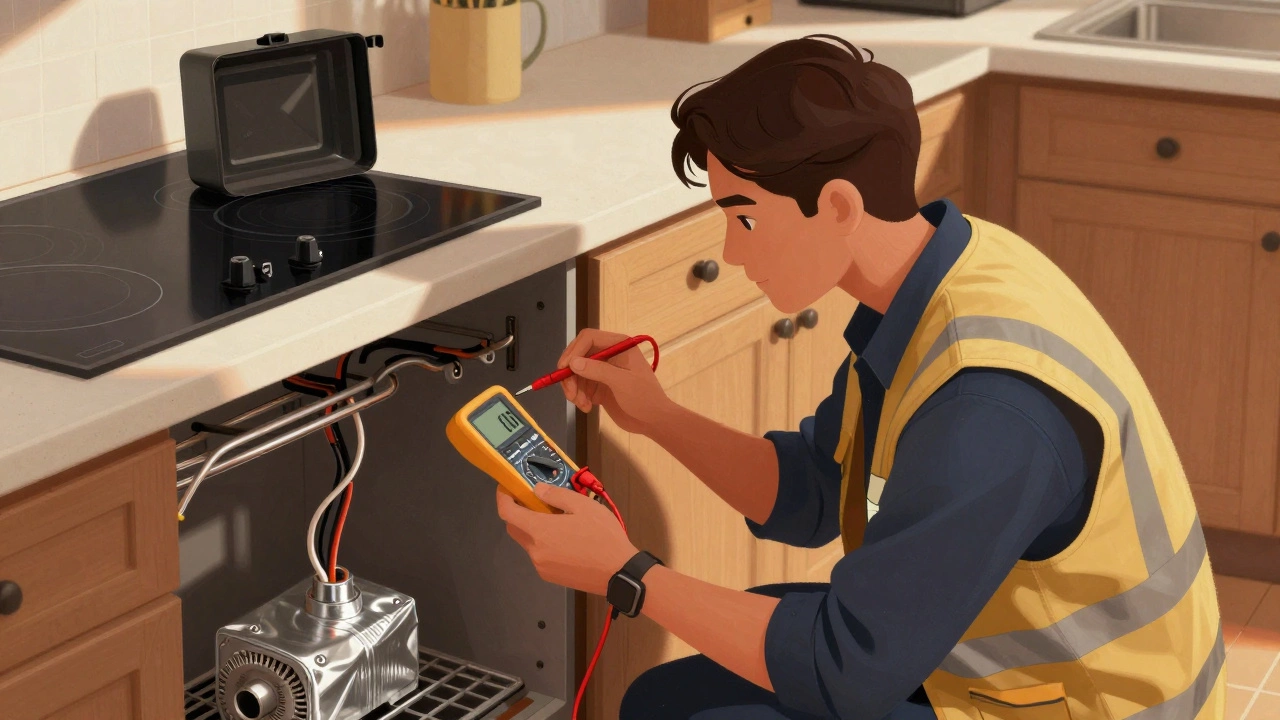
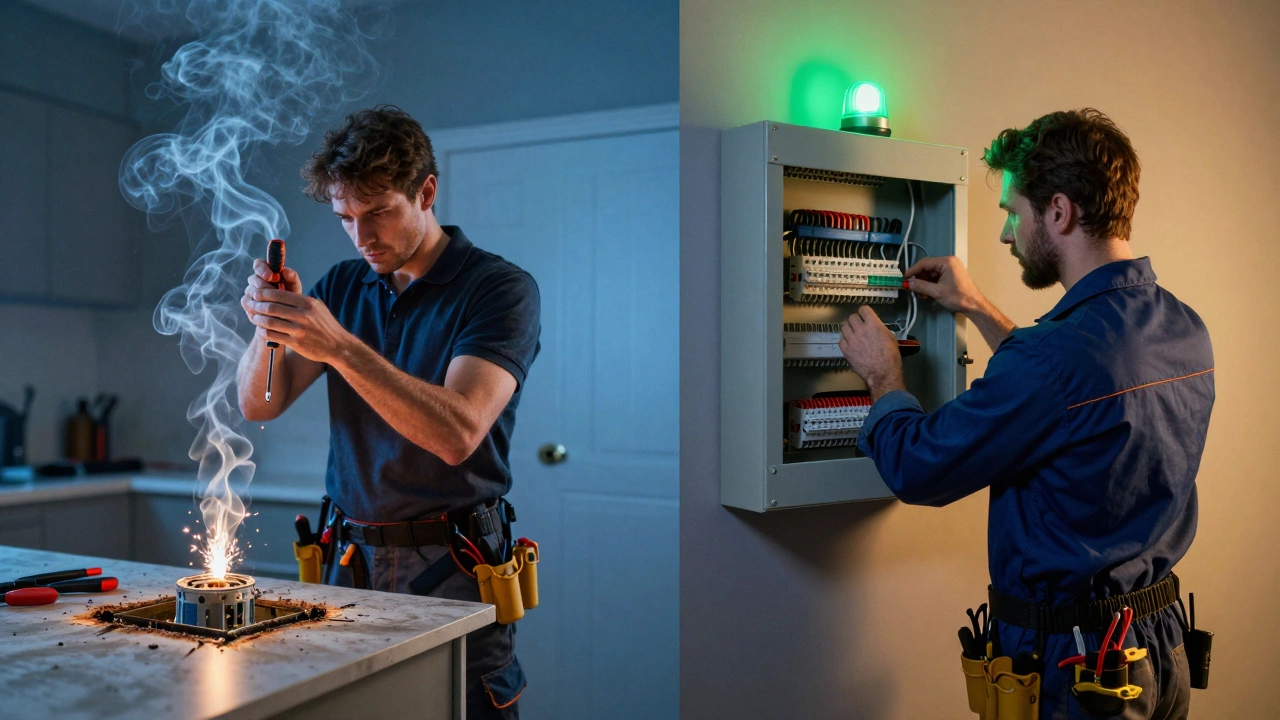
Let’s say you replaced the hob, turned the power back on, and everything worked fine for two weeks. Then one night, the breaker trips, and you smell smoke. You shut it off, but the damage is done. The wires behind the hob are melted. The countertop is scorched. The circuit panel is overloaded.
Now, your homeowner’s insurance won’t cover it. Most policies require electrical work to be done by licensed professionals - especially hardwired appliances. Even if you’re not at fault, if they find out you did the install yourself, they can deny your claim. That’s not a hypothetical. In 2024, over 2,300 insurance claims in British Columbia were denied due to unpermitted electrical work.
And then there’s the warranty. Most hob manufacturers require proof of professional installation to honor their warranty. If your new hob fails after six months and you didn’t hire an electrician, you’re out of luck.
The Real Cost of Skipping an Electrician
Some people think hiring an electrician is expensive. A typical installation in Vancouver runs $250 to $450. But consider this: a new electric hob costs between $800 and $3,000. If you mess up the wiring, you could fry the hob. Or worse - start a fire. The average residential electrical fire costs $40,000 in damages, according to the Canadian Fire Marshal’s Office.
Plus, you’ll need to pay someone to fix your mess. Electricians charge $90 to $130 an hour. A botched install might take 4 hours to undo. That’s $360 right there - not counting the cost of replacing damaged wiring, the hob, or the countertop.
It’s not about fear. It’s about risk vs. reward. Paying $400 upfront saves you from a $40,000 disaster.
What an Electrician Actually Does
When you hire a licensed electrician for a hob replacement, they don’t just swap wires. They do a full inspection:
- Test the existing circuit for proper voltage and amperage
- Check the condition of the junction box and conduit
- Verify grounding and bonding
- Confirm the breaker size matches the new hob’s requirements
- Install a disconnect switch if required by code
- Label the circuit clearly in the panel
- Apply for and schedule a final inspection (if required)
They also know how to handle older homes. In Vancouver, many houses built before 1990 have aluminum wiring. That’s a red flag. Aluminum expands and contracts differently than copper. It can loosen over time and cause arcing. An electrician will know how to safely transition or reinforce those connections.
What About the Appliance Store?
Some stores offer installation. But here’s the fine print: most big-box retailers only install hobs if you bought the unit from them. And their installers aren’t always licensed electricians - they’re appliance technicians. They might handle the physical swap, but they won’t touch the wiring unless it’s a plug-in model.
If your hob is hardwired, they’ll likely tell you to call an electrician anyway. Don’t assume they’ll do the electrical part. Always ask: “Will you handle the wiring, or do I need to hire someone separately?”
Final Checklist: Should You DIY?
Before you reach for that screwdriver, ask yourself:
- Is the new hob identical in size, power, and wiring to the old one?
- Do I know how to turn off the main breaker and test for live wires?
- Is the junction box accessible, clean, and labeled?
- Do I have a voltage tester and wire strippers?
- Am I comfortable following the manufacturer’s wiring diagram exactly?
- Do I have a permit? (In Vancouver, you need one for hardwired changes)
If you answered “no” to any of these - hire an electrician.
If you answered “yes” to all - you *might* be able to do it. But even then, take a photo of the wiring before you disconnect anything. Write down the wire colors and where they connect. Keep the manual. And if you feel unsure for even a second - stop. Call a pro.
Electricity doesn’t care if you’re confident. It only cares if you’re correct.
Can I replace my electric hob myself if I’m handy?
You can, but only if you’re replacing it with an identical model, the wiring is in good condition, and you know how to safely disconnect and reconnect hardwired appliances. Most people overestimate their skills. If you’ve never worked with 240-volt circuits, it’s not worth the risk.
Do I need a permit to replace an electric hob in Vancouver?
Yes, if you’re changing the wiring, upgrading the power, or altering the circuit. Even if you’re doing a like-for-like swap, the city requires a permit for hardwired appliance installations. Skipping it can void your insurance and lead to fines. Most electricians handle the permit process for you.
What’s the difference between an electric hob and a cooktop?
There’s no real difference - “electric hob” and “electric cooktop” are used interchangeably. Both refer to the flat, electric-powered cooking surface built into the countertop. The term “hob” is more common in Canada and Europe, while “cooktop” is used more in the U.S.
Can I use a regular extension cord to plug in my electric hob?
No. Electric hobs are hardwired for safety. They draw too much power for any extension cord. Plugging one in through a cord is a fire hazard and violates the National Electrical Code. If your hob has a plug, it’s not a true electric hob - it’s a portable cooktop, which is a different product entirely.
How long does an electrician take to replace a hob?
Most replacements take 1 to 2 hours if the wiring is already in place. If the circuit needs upgrades, the junction box is damaged, or you’re switching to induction, it can take 3 to 4 hours. The job isn’t about the physical swap - it’s about checking the electrical system behind it.